If you are looking for clean, professional embroidery projects then selecting the best iron for embroidery is important. Embroidery fabric is also very sensitive and if we use more heat, pressure and steam on it then it can flatten some stitches or break threads or leave behind marks.
Embroidery is different from your standard fabric pressing and requires additional skills. An iron with precise temperature control, glides easily and has enough heat to smooth out wrinkles without scorching delicate patterned embroidery.

In this tutorial, we will explore what makes the best iron for embroidery, which components are most essential, and how to select an iron for hand embroidery, machine embroidery, patches, quilting & sewing projects.
What Is the Best Iron for Embroidery?
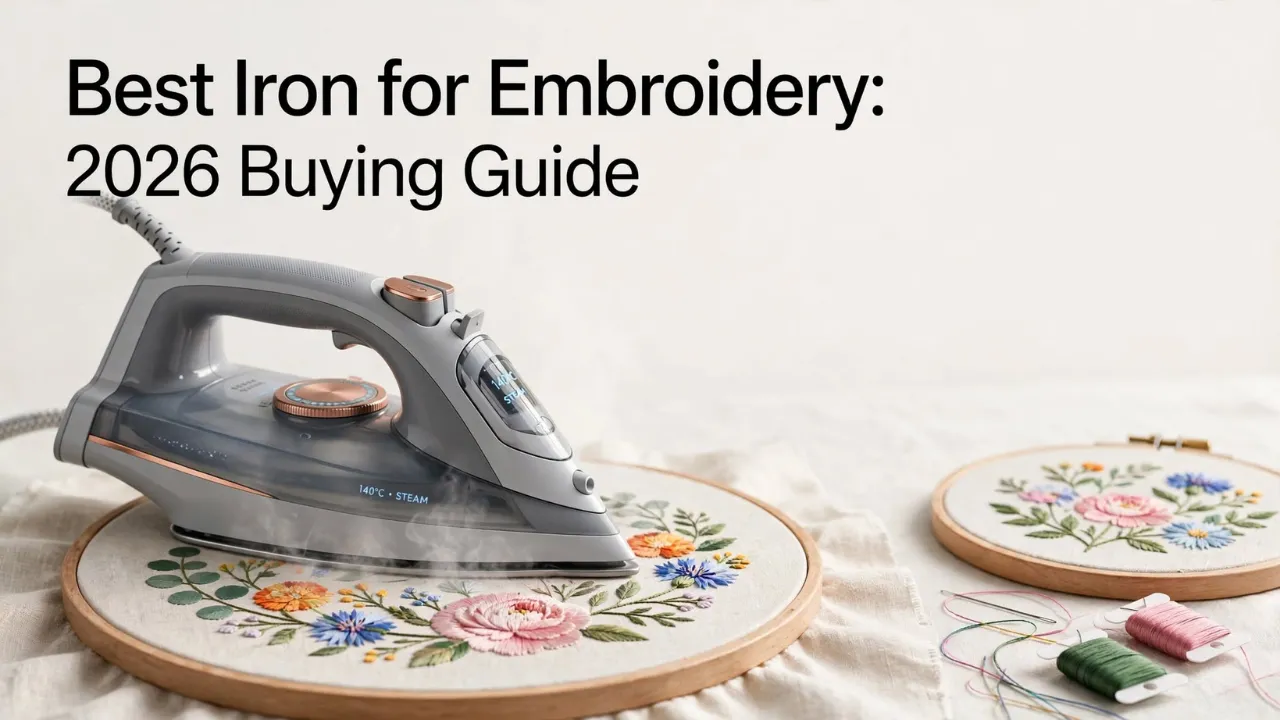
The best iron for embroidery should have precise temperature control, a smooth soleplate, a pointed tip, and adjustable steam settings. These features make it easier to press fabric around detailed embroidery without putting excessive pressure on the stitches.
For most embroidery work, a compact or lightweight iron can be particularly useful. A smaller design gives you better control when pressing small sections of fabric.
A full-size steam iron can also work well, especially if you use your iron for both embroidery and everyday clothing. Sewing experts commonly recommend looking for temperature controls, a pointed soleplate, and suitable steam control when selecting an iron for sewing projects.
Best Iron for Embroidery: Our Top Picks
Here are some types and models worth considering when shopping for the best iron for embroidery.
1. Rowenta Focus Excel – Best for Precision
The Rowenta Focus Excel is a strong choice for embroidery and other detailed sewing projects.
Its pointed design makes it easier to reach small areas of fabric. This is especially useful when you need to press around seams, corners, appliqué, or detailed embroidery.
The model is also designed with numerous steam holes for more even steam distribution. A recent textile-arts review specifically highlights its precision tip as useful for intricate embroidery and small-scale appliqué.
If precision is your main priority, this can be an excellent candidate for the best iron for embroidery.

2. Reliable Velocity – Best for Heavy Embroidery Fabrics
If your embroidery projects involve heavier fabrics, the Reliable Velocity series is worth considering.
It is designed for sewing, quilting, and textile applications. Its strong steam performance can help deal with heavier fabrics and stubborn wrinkles.
The iron also provides temperature control, which is important when switching between different fabrics.
For embroidery artists who regularly work with denim, cotton, or multiple layers, a powerful iron can make pressing easier.

3. Panasonic Cordless Iron – Best for Maneuverability
A cordless iron can be convenient for embroidery because there is no power cord getting in the way.
The Panasonic NI-WL600 has been highlighted as a cordless choice for textile work. Its cordless design allows greater freedom when moving around a project.
For small embroidery projects, this flexibility can make pressing more comfortable.
However, cordless irons need to be returned to their charging base periodically. If you frequently work on large projects, a traditional corded model may be more convenient.

4. Oliso Pro – Best for Sewing and Quilting
The Oliso Pro range is another option for people who want an iron for sewing, quilting, and embroidery-related projects.
A major advantage of a sewing-focused iron is control. When you are working with embroidered fabric, you do not always want to press the entire surface aggressively.
A responsive iron allows you to make short pressing movements and focus heat exactly where it is needed.

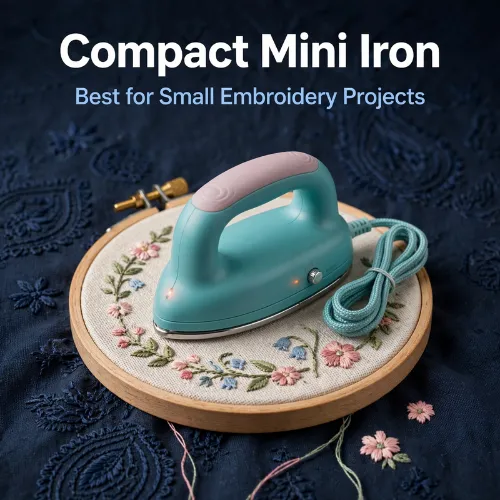
5. Compact Mini Iron – Best for Small Embroidery Projects
A mini iron can be one of the most practical choices for detailed embroidery.
Its small soleplate makes it easier to work around small designs, narrow seams, appliqué, and embroidery patches.
Mini irons are especially useful for crafters who have limited workspace.
However, they may not be the best choice if you also need to iron large garments regularly. In that case, a full-size iron may provide better versatility.
Why You Need the Best Iron for Embroidery
Embroidery adds texture to fabric. Threads can create raised areas that make ordinary ironing techniques unsuitable.
If you press directly over thick embroidery with excessive force, the stitches may become flattened.
The wrong temperature can also damage synthetic embroidery threads or delicate fabrics.
That is why the best iron for embroidery should give you control rather than simply maximum heat.
A good iron lets you select an appropriate temperature for your fabric and adjust steam according to the project.
The American Sewing Guild also points out that temperature control, soleplate shape, steam holes, and weight are important considerations when choosing an iron for sewing.
Also read:Best Iron for Quilting 2026 Buying Guide
Important Features of the Best Iron for Embroidery
1. Precise Temperature Control
Temperature control is one of the most important features of the best iron for embroidery.
Different fabrics require different heat levels.
Cotton can generally tolerate more heat than delicate synthetic materials. Silk and some synthetic fabrics require much more care.
Look for an iron with clearly marked temperature settings.
A dial with fabric settings can be useful for beginners, while digital temperature controls may appeal to users who want more precise adjustments.
Always check the fabric manufacturer’s care instructions before ironing.
2. Smooth Soleplate
The soleplate is the part of the iron that touches the fabric.
For embroidery, you want a soleplate that glides smoothly.
Ceramic and non-stick soleplates are popular choices because they generally glide easily and can reduce sticking. A current Pakistan iron-buying guide similarly recommends ceramic or non-stick soleplates for smooth movement and reduced sticking.
A smooth soleplate can make a major difference when moving around embroidered fabric.
3. Pointed Tip
A pointed tip is extremely useful when looking for the best iron for embroidery.
Embroidery often includes small corners, narrow seams, and detailed areas.
A pointed tip lets you concentrate heat on a smaller section.
It can also help when pressing seams close to embroidery designs.
For detailed craft work, I would generally prioritize a precision tip over an oversized soleplate.
4. Adjustable Steam
Steam can be useful for removing wrinkles from fabric.
However, embroidery projects do not always need steam.
When working with delicate materials, excessive moisture can sometimes be undesirable.
For this reason, choose an iron with a genuine steam-off option and adjustable steam control.
For heat-activated embroidery patches and adhesive applications, steam is often specifically discouraged because moisture can interfere with adhesive bonding.
This makes steam control an important feature of the best iron for embroidery.
5. Lightweight Design
A lightweight iron can be easier to control during detailed work.
Embroidery often requires short movements rather than long strokes.
A heavy iron may provide useful pressure for tailoring and thick fabrics, but it can become tiring during detailed craft projects.
If you primarily embroider small designs, a lightweight iron may be more comfortable.
6. Auto Shut-Off
Safety should not be ignored.
An automatic shut-off feature can turn the iron off after a period of inactivity.
This is particularly useful in craft rooms where you may become distracted by your sewing machine, threads, needles, or other materials.
When shopping for the best iron for embroidery, consider safety features alongside performance.
Steam Iron vs Dry Iron for Embroidery
Should you buy a steam iron or a dry iron?
The answer depends on your projects.
A steam iron gives you additional flexibility because you can use steam when appropriate and turn it off when necessary.
A dry iron is simpler and does not have a water tank.
For embroidery, having the ability to turn steam completely off can be particularly valuable.
If you also iron clothes, a steam iron may provide better overall versatility.
If your main purpose is craft work, a simple dry or mini iron can sometimes be sufficient.
The important thing is having good temperature control.
Best Iron for Embroidery Patches
Embroidery patches require special attention.
If the patch uses heat-activated adhesive, temperature and pressure become especially important.
Do not automatically use maximum heat.
Instead, follow the patch manufacturer’s instructions.
For iron-on applications, a pressing cloth can help protect the embroidery and fabric.
Some heat-transfer instructions recommend turning steam off and using a firm, flat surface because steam and uneven pressure can affect the adhesive result.
A controlled iron is therefore a better choice than simply choosing the hottest model.
Best Iron for Machine Embroidery
Machine embroidery can produce dense designs with many layers of thread.
After embroidery, the fabric may need pressing to remove hoop marks and wrinkles.
The best iron for embroidery in this situation should provide good temperature control and a smooth soleplate.
Avoid pushing aggressively over raised stitching.
Instead, press carefully from the reverse side when appropriate.
Using a pressing cloth can provide another layer of protection.
For machine embroidery, a smaller iron can also help you work around intricate designs.
Best Iron for Hand Embroidery
Hand embroidery requires a slightly different approach.
Hand-embroidered pieces can contain delicate stitches, decorative threads, beads, or other embellishments.
For these projects, direct high heat may not be appropriate.
Pressing from the reverse side can help protect raised stitches.
A towel or padded surface can also provide support for the embroidery.
The goal is to remove wrinkles without crushing the texture created by the stitching.
This is one reason a precise, controllable iron is often better than a heavy-duty iron.
How to Iron Embroidery Correctly
Even the best iron for embroidery can damage fabric if used incorrectly.
Start by checking the fabric care label.
Set the iron to an appropriate temperature.
If you are unsure, begin with a lower setting.
Place the embroidered fabric on a suitable ironing surface.
For raised embroidery, consider pressing from the reverse side rather than directly over the stitches.
Move the iron gently.
Avoid leaving a hot soleplate stationary on one section for too long.
For delicate fabrics, use a pressing cloth.
The exact temperature should always depend on the fabric and embroidery materials rather than using one universal setting.
Should You Use Steam on Embroidery?
Steam can be helpful, but it is not always necessary.
For ordinary cotton fabric, steam may make wrinkle removal easier.
For delicate materials or adhesive embroidery patches, however, you may want steam turned off.
Some embroidery finishing guidance recommends pressing from the reverse side first so that the stitches are supported rather than flattened from the front.
Therefore, the best iron for embroidery is one that lets you control steam easily.
Ceramic vs Stainless Steel Soleplate
When choosing the best iron for embroidery, soleplate material deserves attention.
Ceramic Soleplate
Ceramic is popular because it generally provides smooth movement.
It can be a good choice for people who want an easy-gliding iron for both embroidery and clothing.
Stainless Steel Soleplate
Stainless steel can also provide smooth movement and durability.
However, the exact performance depends on the design and finish of the individual iron.
Non-Stick Soleplate
Non-stick coatings can be useful for sewing and craft work, particularly when working with materials that could otherwise stick.
The American Sewing Guild notes that non-stick coatings can be especially useful for users who do a lot of fusing.
What Wattage Is Best for Embroidery?
Wattage affects how quickly an iron heats and how strongly it can produce steam.
For general household ironing, higher wattage can be useful.
For embroidery, however, maximum wattage should not be your only consideration.
Temperature control is more important.
A current iron guide suggests that around 1,800–2,400 watts is useful for heavier household ironing, while lower wattage can work for lighter use.
For craft work, choose a balance between heat-up speed, control, weight, and steam performance.
Common Mistakes When Ironing Embroidery
Pressing Directly on Raised Stitches
One of the biggest mistakes is pressing hard directly over raised embroidery.
This can flatten the design.
Using Too Much Heat
More heat does not always mean better results.
High temperatures can damage synthetic threads and delicate fabrics.
Using Steam for Iron-On Patches
Steam may interfere with some adhesive applications.
Always follow the manufacturer’s instructions.
Moving Too Quickly
Give the fabric enough time to respond to the heat.
Controlled pressing is better than aggressively moving the iron back and forth.
Ignoring the Fabric
The embroidery thread is only one part of the project.
You must also consider the fabric underneath.
How to Choose the Best Iron for Embroidery
Before buying, consider these questions:
Do you mostly embroider small designs?
Choose a compact iron with a precision tip.
Do you work with clothing and embroidery?
Choose a full-size steam iron with adjustable steam.
Do you make patches?
Choose an iron with accurate temperature control and a steam-off setting.
Do you work with heavy fabrics?
Consider a stronger iron with good heat retention and steam output.
Do you travel with your embroidery projects?
A compact or cordless iron may be more convenient.
Do you have limited workspace?
A mini iron can be easier to store and maneuver.
Best Iron for Embroidery: Quick Comparison
| Iron Type | Best For | Main Advantage |
|---|---|---|
| Mini Iron | Small embroidery | Excellent control |
| Steam Iron | Mixed projects | Versatile |
| Cordless Iron | Craft rooms | Easy movement |
| Precision Iron | Detailed embroidery | Pointed tip |
| Heavy Steam Iron | Thick fabrics | Strong steam |
| Dry Iron | Patches and simple pressing | Simple operation |
Final Verdict: Which Is the Best Iron for Embroidery?
The best iron for embroidery depends on the type of projects you create.
For detailed embroidery, prioritize a compact design, pointed tip, smooth soleplate, and precise temperature control.
For people who want one iron for embroidery and everyday clothing, a quality steam iron is the more versatile option.
For patches and heat-activated projects, a reliable temperature setting and steam-off function are particularly important.
If you frequently work with delicate fabrics, avoid choosing an iron based only on maximum heat or steam power.
Instead, focus on control, precision, soleplate quality, weight, and safety.
A good embroidery iron should make your craft easier rather than create additional problems. Choose a model that matches your fabric types, project sizes, and frequency of use.
Most importantly, always test your chosen temperature on a small or hidden section of fabric first. With the right technique and the best iron for embroidery, you can achieve smoother fabric, cleaner seams, and more professional-looking embroidery projects.
Frequently Asked Questions
What is the best iron for embroidery?
The best iron for embroidery is one with accurate temperature control, a smooth soleplate, a precision tip, and adjustable steam. For detailed projects, a compact or precision iron can be particularly useful.
Can I use a regular iron for embroidery?
Yes. A regular household iron can work well for embroidery if it has suitable temperature control. Use the correct heat setting and avoid pressing directly and heavily on raised stitches.
Is steam good for embroidery?
Steam can help remove wrinkles, but it is not suitable for every embroidery project. When working with adhesive patches or delicate materials, check the manufacturer’s instructions before using steam.
Should I iron embroidery from the front or back?
For many embroidered projects, pressing from the reverse side can help protect raised stitches. A pressing cloth can provide additional protection.
Is a mini iron better for embroidery?
A mini iron can be better for small and detailed embroidery because it offers greater control. However, a full-size iron is more versatile if you also need to iron clothing.
What temperature should I use for embroidery?
There is no single temperature for every embroidery project. Choose the temperature based on the fabric, embroidery thread, and manufacturer’s care instructions.
Can I use an iron for embroidery patches?
Yes. An iron can be used for many iron-on embroidery patches. Follow the patch manufacturer’s temperature, pressure, and timing instructions carefully.


1 Comment
[…] Also read:Best Iron for Embroidery: 2026 Buying Guide […]