
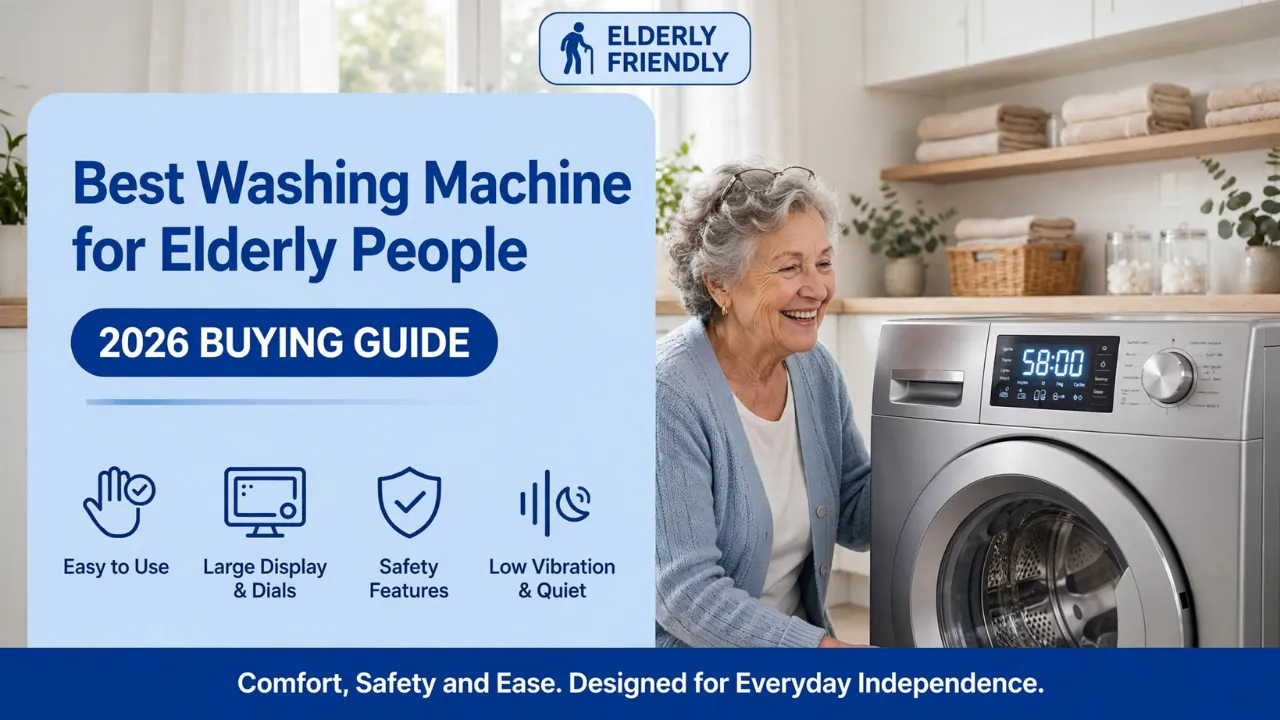
It should also be easy to operate, have convenient handling (a machine that is not difficult to load or reach), and be dependable for daily laundry. When it comes to selecting a washing machine for older adults, the choice isn’t merely about cleaning effectiveness. The controls, door or lid type, loading height, cycle settings and maintenance can all be decisive once you are purchase the dryer.
This can make laundry much more complicated than it needs to be when you have a washing machine with so many very tiny buttons and so many confounding settings. For everyday washing, even in a simple model format with large controls and easy reach.

This guide tells you how to select the Best washing machine for Elderly People, which features are most useful, top-load or front-load washer is better, and what features do not matter.
What Makes a Washing Machine Good for Elderly People?
The Best Washing Machine for Elderly People should reduce the physical effort required to complete a normal laundry cycle.
Simple operation is one of the most important factors. Large buttons, readable labels, an easy-to-use dial, and a clear display can make the machine much easier to understand.
Accessibility guidance also recommends looking for controls that are easy to see, press, and operate. Large, high-contrast controls and clear feedback can be particularly useful for people with limited vision or dexterity.
Loading is equally important.
A washing machine that requires repeated bending, stretching, or reaching deep inside the drum may become uncomfortable for some older adults.
The right design can reduce these difficulties and make laundry more manageable.
Best Washing Machine for Elderly People: Top-Load or Front-Load?
One of the biggest decisions is choosing between a top-load and front-load washing machine.
Both designs have advantages.
Top-Load Washing Machines
Top-load washers are often convenient because the opening is located at the top.
You do not need to bend down as much to put clothes into the machine or remove them after washing.
For some elderly users, this can make a top-load washer particularly comfortable.
Modern top-load machines are also available with automatic wash programs, electronic controls, and automatic water-level sensing.
If bending down is difficult, a top-load washer may be the better choice.
However, a very deep tub can make it difficult to reach small items at the bottom. A smaller-capacity top-loader with a shallower tub may be easier to access.

Front-Load Washing Machines
Front-load washers have their opening on the front.
They can be very accessible because the controls and door are generally located together at the front of the appliance.
They can also be raised using a compatible pedestal, reducing the amount of bending required when loading and unloading.
Accessibility experts specifically note that front-load washers can be easier to access for people with mobility limitations or back problems, especially when installed at a comfortable height.
The disadvantage is that a standard front-load washer may require bending down.
For an elderly person who has difficulty bending, a pedestal or raised installation can make a significant difference.

Also read:Best Washing Machine for Low Water Pressure: 2026 Buying Guide
Easy-to-Use Controls
Controls are one of the most important features when choosing the Best Washing Machine for Elderly People.
Avoid machines with overly complicated touchscreens if the user prefers physical controls.
Large buttons and clearly marked dials are generally easier to understand.
The labels should have strong contrast against the control panel.
A large cycle selector can also be helpful because it allows the user to physically identify the selected setting.
Accessibility guidance recommends large, easy-to-press buttons and controls that are well spaced rather than crowded together.
Large and Clear Display
A clear display can make a washing machine easier to operate.
Look for large numbers and easy-to-read text.
The display should clearly show information such as remaining time, selected cycle, temperature, and error messages.
A backlit display can be especially useful in a laundry room with limited lighting.
For people with reduced vision, high contrast between controls and their background can improve visibility.
Simple Wash Programs
More programs do not always mean a better washing machine.
A machine with 20 or 30 different cycles may look impressive, but many users only need a few basic options.
The Best Washing Machine for Elderly People should make everyday laundry straightforward.
Useful programs include:
- Normal
- Quick Wash
- Delicate
- Heavy Duty
- Towels
- Bedding
- Rinse and Spin
A simple machine may be preferable if the user does not want to navigate complicated menus.
A favorite-cycle or one-touch function can also make repeated laundry easier.
Large Door or Lid
The door or lid should be easy to open and close.
For front-load washers, look for a wide door opening and an easy-to-grip handle.
A door that opens widely can make loading and unloading more convenient.
Accessibility guidance recommends checking whether the door is easy to grip and whether it provides enough room for comfortable loading.
For top-load washers, check the lid.
A lightweight lid that opens smoothly is preferable to one that requires significant force.
Comfortable Loading Height
Loading height is especially important when shopping for the Best Washing Machine for Elderly People.
A front-load washer positioned directly on the floor may require considerable bending.
A compatible pedestal can raise the washer and make the opening more comfortable to reach.
If choosing a top-loader, consider the height and depth of the tub.
A very deep washer may force the user to reach farther down.
The best choice depends on the person’s height, mobility, and preferred loading position.
Automatic Detergent Dispensing
Automatic detergent dispensing can make laundry easier.
Instead of measuring detergent for every load, the user fills the dispenser and allows the washer to automatically dispense an appropriate amount.
This reduces one extra step.
It can also help prevent excessive detergent use.
Some modern washing machines include automatic detergent and fabric-softener dispensing systems.
However, this feature can increase the price of the appliance.
If simplicity and affordability are priorities, a basic detergent drawer may be perfectly adequate.
Quiet Operation
A quiet washing machine can make the laundry experience more comfortable.
This is especially useful if the washer is located near bedrooms, living areas, or a home office.
Look for models with quiet motors and vibration-control systems.
An inverter motor may provide smoother operation on some models, although the overall design and installation also affect noise.
A washing machine that is properly leveled can operate more quietly than one that rocks or vibrates during spinning.
Automatic Shutoff and Safety Features
Safety should also be considered.
Modern washing machines typically include systems that stop the cycle if a problem occurs.
Look for features such as child locks, door locks, overflow protection, and automatic error detection.
The controls should also make it obvious when the machine is running.
A clear end-of-cycle signal can help users know when laundry is ready.
For some users, audible feedback is particularly useful. Accessibility guidance notes that sounds can provide confirmation when a button is pressed or a cycle finishes.
Self-Cleaning Features
Maintenance can become another concern.
A self-cleaning cycle can reduce the effort required to maintain the washing machine.
Some modern washers include drum-cleaning programs that help remove residue and buildup.
This can be useful for users who prefer an appliance that requires less manual maintenance.
Still, the detergent drawer, door area, lint filter, and other accessible parts may require occasional cleaning.
Capacity: What Size Is Best?
Capacity should match the user’s normal laundry needs.
A single person may not need a very large washing machine.
A smaller capacity can also make the drum easier to reach.
For a couple or small household, a medium-capacity machine can provide a good balance between convenience and laundry volume.
Larger families may benefit from a bigger drum.
However, buying the biggest machine available is not necessarily the best decision.
A large drum can be deeper and harder to reach.
The Best Washing Machine for Elderly People should provide enough capacity without creating unnecessary accessibility problems.
Energy and Water Efficiency
Efficiency is another factor worth considering.
Modern washing machines increasingly use sensors to adjust water and cycle settings according to the load.
Energy-efficient models can help reduce long-term operating costs.
Current 2026 washing-machine testing also emphasizes cleaning performance, water and energy efficiency, and useful convenience features when comparing models.
However, efficiency should not come at the expense of usability.
A washer that saves a small amount of energy but has difficult controls may not be the best choice for an elderly user.
Ease of use should come first.
Smart Washing Machines: Are They Worth It?
Smart washing machines can connect to smartphones and home networks.
They may offer notifications, remote controls, cycle monitoring, and troubleshooting information.
These features can be useful for family members who help an elderly relative manage laundry.
For example, a family member may receive a notification when a cycle has finished.
However, smart technology is not necessary for everyone.
If the user prefers physical controls and simple operation, a traditional washer may be better.
Do not buy a smart washing machine simply because it has more technology.
Choose features that the person will actually use.
Best Washing Machine for Elderly People With Limited Vision
For users with limited vision, the control layout becomes especially important.
Choose a washing machine with large labels and strong contrast.
Large buttons and tactile markings can also help.
Some accessible appliances provide tactile or audible feedback.
The American Foundation for the Blind notes that accessible washer controls can include tactile buttons, audible feedback, and clearly identifiable control functions.
Avoid control panels covered with tiny icons that are difficult to distinguish.
A simple physical dial may be easier to understand than a complicated touchscreen.
Best Washing Machine for Elderly People With Limited Mobility
For limited mobility, focus on reducing bending and reaching.
A raised front-load washer can be useful because the opening can be positioned at a more comfortable height.
A top-load washer can also be a good option because loading occurs from above.
The better option depends on the individual’s mobility.
Before buying, think about how the person actually performs laundry.
If possible, let the user test the controls, door, lid, and detergent drawer before purchasing.
Best Washing Machine for Elderly People: Features to Prioritize
When comparing models, prioritize these features:
- Simple controls
- Large buttons
- Clear labels
- High-contrast display
- Easy-to-turn dial
- Wide door opening
- Easy-to-grip handle
- Comfortable loading height
- Simple wash programs
- Automatic detergent dispensing
- Quiet operation
- End-of-cycle signal
- Self-cleaning cycle
- Appropriate capacity
- Good warranty
- Reliable local service
Not every washer will include all of these features.
Choose the combination that best matches the user’s needs.
Common Mistakes to Avoid
One mistake is choosing a washing machine based only on cleaning power.
An extremely powerful washer may still be inconvenient if the controls are difficult to use.
Another mistake is choosing an oversized model.
A larger drum can be harder to reach.
Some buyers also choose a machine with too many smart features.
More technology can sometimes mean more complicated controls.
Another mistake is ignoring installation height.
For a front-load washer, the installation position can strongly affect accessibility.
Finally, do not forget maintenance.
A machine that is difficult to clean may become frustrating over time.
Should You Buy a Washer-Dryer Combo?
A washer-dryer combo can reduce the number of times laundry needs to be moved between appliances.
This can be convenient for an elderly person.
Instead of transferring wet clothes from the washer to a separate dryer, the same machine can perform both tasks.
However, washer-dryer combos can have smaller drying capacities than their washing capacities, meaning a full wash load may not always be dryable in one cycle.
They can also cost more than a basic washing machine.
If transferring clothes between appliances is difficult, the convenience may justify the additional cost.
How to Choose the Best Washing Machine for Elderly People
Start by identifying the user’s biggest difficulty.
Is bending difficult?
Choose a top-loader or consider a raised front-loader.
Is reaching difficult?
Look for a shallower drum and a wide opening.
Is vision the main concern?
Choose large, high-contrast controls.
Is hand strength limited?
Avoid stiff knobs and difficult door handles.
Does the user prefer simplicity?
Choose a machine with fewer programs and straightforward controls.
This approach is better than simply choosing the most expensive model.
Final Buying Checklist
Before purchasing the Best Washing Machine for Elderly People, ask these questions:
- Are the controls large and easy to understand?
- Can the user easily open the door or lid?
- Is loading and unloading comfortable?
- Does the machine require excessive bending?
- Is the display easy to read?
- Are the most-used cycles easy to find?
- Is the detergent drawer easy to operate?
- Does the machine provide useful end-of-cycle feedback?
- Is the washer quiet enough for the home?
- Is the capacity appropriate?
- Is maintenance straightforward?
- Is there reliable warranty and service support?
If the answer to most of these questions is yes, the washer is likely to be a practical choice.
Final Verdict
The Best Washing Machine for Elderly People is not necessarily the most expensive or technologically advanced model.
The best washer is the one that makes laundry simple, comfortable, and manageable.
For users who have difficulty bending, a top-load washer or raised front-load washer can be a practical choice.
For users with limited vision or dexterity, prioritize large controls, clear labels, strong contrast, tactile features, and useful audio feedback.
For people who want minimum effort, automatic detergent dispensing, simple programs, self-cleaning functions, and end-of-cycle notifications can be valuable.
Most importantly, think about the actual person who will use the appliance.
A washing machine with fewer features but easier controls may be a much better purchase than a premium model packed with technology.
Frequently Asked Questions
What is the best washing machine for elderly people?
The Best Washing Machine for Elderly People is one that matches the user’s physical abilities and preferences. Look for simple controls, readable labels, easy loading, a comfortable height, and useful automatic functions.
Is a top-load washing machine better for elderly people?
A top-load washer can be easier for people who have difficulty bending because clothes are loaded from above. However, a deep tub may be difficult to reach. The best choice depends on the user’s height and mobility.
Is a front-load washing machine good for seniors?
Yes. A front-load washer can be a good choice, especially when installed on a compatible pedestal. This can reduce bending and make the controls and door easier to access.
What washing machine has the easiest controls?
Look for models with a large physical dial, clearly labeled buttons, high-contrast text, and a simple selection of common cycles. Avoid unnecessarily complicated touchscreens if the user prefers traditional controls.
Are smart washing machines good for elderly people?
Smart washers can be useful when family members want remote notifications or monitoring. However, they are not automatically easier to operate. For many users, straightforward physical controls may be more convenient.
What size washing machine is best for elderly people?
Choose a capacity that matches the household’s laundry needs. A medium-capacity washer can be easier to access than an extremely large machine because the drum may be shallower.


1 Comment
[…] Also read:Best Washing Machine for Elderly People: 2026 Buying Guide […]