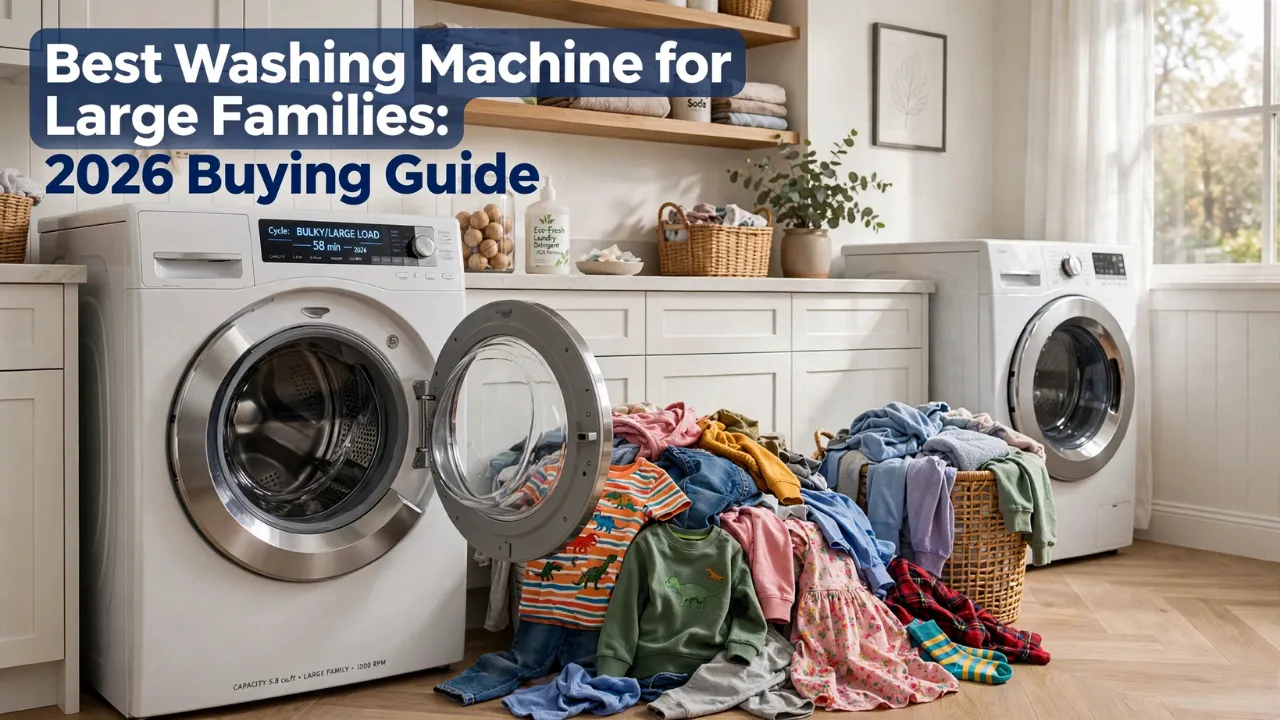
Searching for the best washing machine for large families can be invaluable when it feels like piles of dirty clothes never stop coming in. If you have kids, several adults living together, or regularly wash bedding loads, a washer must have ample capacity, solid cleaning performance and features you can use well every day.
A small washing machine might need multiple trips each day. This means it is capable of washing more clothes, towels, sheets, and other bulky items in fewer cycles compared to a larger machine.
While capacity can still be a concern for 2026, shoppers should be focused on other things. Get to know the washing machine features that are relevant for you, such as water and energy efficiency, wash performance, cycle options, noise, smart features, durability and ease of maintenance.

In this guide, we outline the features of ideal washing machines for large families and compare major considerations before deciding which type of washer might work best in your home.
What Is the Best Washing Machine for Large Families?
The best washing machine for large families is usually a full-size washer with a large drum, strong cleaning performance, efficient water usage, and flexible wash cycles.
For many households, a washer around 5.0 to 5.8 cubic feet is a practical choice. Larger capacities can be particularly useful when you regularly wash comforters, towels, bedding, and large family loads.
ENERGY STAR recommends considering both the physical space available and the amount of laundry your household normally washes. Certified models are available in different drum capacities and configurations.
A large washer should also be efficient. ENERGY STAR says certified clothes washers use about 20% less energy and about 30% less water than standard models.
Quick Comparison: Best Washing Machines for Large Families
| Washer Type | Best For | Typical Advantage |
|---|---|---|
| Large Front Load | Maximum efficiency | Excellent water and energy savings |
| Large Top Load | Easy loading | Convenient access and large capacity |
| Top Load Impeller | Large loads | More usable drum space |
| Smart Washer | Connected homes | Remote controls and notifications |
| Washer-Dryer Combo | Limited space | Washing and drying in one appliance |
1. Large-Capacity Front-Load Washer
A large front-load washer is one of the strongest options for a busy family.
Front-load machines generally use less water than traditional top-load agitator machines. ENERGY STAR reports that certified front-load washers can use substantially less energy and water than conventional top-load agitator models.
The horizontal drum also provides plenty of usable space for large loads.
This makes a large front-loader a good choice for families that frequently wash:
- Bedding
- Towels
- Children’s clothing
- Jeans
- Sportswear
- Blankets
- Large mixed loads

The main disadvantage is that front-load washers can require more attention to door seals and cleaning routines. Leaving the door open between washes can help the interior dry.
2. Large-Capacity Top-Load Washer
A top-load washer is another excellent choice for large households.
Its biggest advantage is convenience. You do not need to bend down as much to load and unload clothing, and many models allow you to add forgotten items during a cycle.
Top-load washers are also available with very large drums.
There are two main designs to consider: agitator and impeller.
Top Load With Agitator
Traditional agitator washers use a central mechanism to move clothing through the water.
They can provide vigorous cleaning and are familiar to many households.
However, the agitator takes up some space inside the drum. This can reduce the usable area for bulky laundry.
Top Load With Impeller
An impeller uses a low-profile disc or similar mechanism instead of a tall central agitator.
This design leaves more room for clothes.
For a large family that frequently washes comforters, towels, and bulky loads, an impeller washer can therefore be worth considering.

How Much Capacity Does a Large Family Need?
Also read:Best Washing Machine for Elderly People: 2026 Buying Guide
Capacity is one of the most important factors when choosing the best washing machine for large families.
A useful starting point is:
- 3.5–4.4 cu. ft.: Smaller households
- 4.5–4.9 cu. ft.: Medium-sized families
- 5.0–5.5 cu. ft.: Large families
- 5.5+ cu. ft.: Very large households and bulky loads
These are practical shopping ranges rather than strict industry classifications.
The right capacity depends on your laundry habits.
A family of five that washes clothes every day may be perfectly happy with a 5.0-cu.-ft. machine. Another family of four that washes large bedding loads may prefer something larger.
ENERGY STAR also notes that larger usable capacity can mean fewer loads, particularly when washing large items such as comforters.
Best Washing Machine for Large Families: Features to Look For
Choosing the best washing machine for large families becomes easier when you know which features actually matter.
1. Large Drum Capacity
Capacity should be near the top of your list.
A larger drum allows you to wash more clothes per cycle and makes bulky items easier to clean.
However, do not automatically choose the largest washer available.
Make sure the machine will physically fit your laundry area.
2. Multiple Wash Cycles
Large families usually wash many different types of clothing.
Look for cycles such as:
- Normal
- Heavy Duty
- Delicates
- Towels
- Bedding
- Quick Wash
- Sanitize
- Cold Wash
More useful cycles allow you to select the appropriate treatment for different fabrics.
3. High Spin Speed
A powerful spin cycle removes more water from clothing before the load enters the dryer.
This can reduce drying time.
For a large family, this feature can become particularly valuable because you may be washing multiple loads every day.
4. Energy Efficiency
Energy efficiency should not be overlooked.
A family running the washing machine frequently can accumulate significant utility costs over time.
ENERGY STAR recommends checking the yellow EnergyGuide label to compare energy consumption and estimated annual operating costs.
Look for ENERGY STAR certification when available.
5. Water Efficiency
Water consumption is another important consideration.
ENERGY STAR uses the Integrated Water Factor (IWF) to compare water efficiency among qualifying residential washers. A lower IWF indicates better water efficiency.
This can be especially useful for families that run many laundry cycles.
6. Stain Removal
Parents with children may deal with grass, food, mud, and other difficult stains.
A washer with specialized stain-removal options can be useful.
Features such as pre-soak, extra rinse, steam, or dedicated stain cycles may provide additional flexibility.
7. Noise Control
Laundry rooms are not always located away from bedrooms.
If your washing machine operates near living spaces, choose a model designed for quieter operation.
This is particularly important for families who run laundry at night.
8. Smart Features
Smart washers can provide useful convenience.
Depending on the model, connected features may allow you to:
- Start or stop cycles remotely
- Receive cycle notifications
- Check remaining time
- Download additional cycles
- Receive maintenance alerts
Smart functions are not essential, but they can make a busy household’s laundry routine easier.
Front Load vs. Top Load for Large Families
The debate between front-load and top-load machines is important when shopping for the best washing machine for large families.
Front-Load Advantages
Front-load washers typically offer:
- Excellent water efficiency
- Strong cleaning performance
- Large usable drum space
- Good handling of bulky items
- Stackable installation on compatible models

ENERGY STAR says front-load certified washers use substantially less energy and water than top-load agitator washers.
Front-Load Disadvantages
Potential drawbacks include:
- More bending during loading
- Door gasket maintenance
- Longer wash cycles on some models
- Need for adequate door clearance
Top-Load Advantages
Top-load washers offer:
- Easy loading
- Convenient access
- No front door seal to manage
- Many large-capacity options
- Familiar controls
Top-Load Disadvantages
Traditional agitator models may provide less usable space inside the drum.
They can also use more water than efficient front-load or impeller designs.
What Is the Best Washing Machine Size for a Family of 5?
For a family of five, a washer around 5.0 cubic feet or larger is often a practical target.
This provides enough room for larger clothing loads and many bulky items.
If your household frequently washes comforters, towels, sports uniforms, or bedding, moving toward a larger capacity can be worthwhile.
However, capacity should not be considered alone.
A slightly smaller ENERGY STAR-certified washer may be a better long-term choice than a much larger inefficient model.
Is a 5.0 Cu. Ft. Washer Big Enough for a Large Family?
Yes, a 5.0 cu. ft. washer can be large enough for many large families.
It can handle substantial everyday loads and can provide enough space for many bulky household items.
The important question is how frequently your household does laundry.
If you wash small loads every day, 5.0 cu. ft. may be more than enough.
If you regularly wash several large bedding loads each week, you may benefit from a 5.5-cu.-ft. or larger model.
What Is the Best Type of Washing Machine for a Large Family?
For most large households, a full-size front-load or large-capacity top-load washer is the best place to start.
Choose a front-loader if your priority is efficiency and maximum usable drum space.
Choose a top-loader if easy loading and unloading are more important.
For families with lots of bulky laundry, a high-capacity impeller top-loader can also be an attractive option.
Energy Efficiency: Why It Matters for Large Families
A large family may run hundreds of laundry cycles each year.
ENERGY STAR estimates that the average American family washes about 300 loads annually.
If your household washes substantially more than that, efficiency becomes even more important.
Instead of looking only at the purchase price, consider the washer’s long-term operating costs.
Check:
- EnergyGuide information
- ENERGY STAR certification
- Annual energy consumption
- Water consumption
- Available efficiency settings
A slightly more expensive efficient washer can potentially provide better value over its useful life.
Best Washing Machine for Large Families on a Budget
If you are shopping on a budget, you do not necessarily need the most expensive smart washer.
A good budget-friendly family washer should prioritize:
- Large capacity
- Reliable wash performance
- Useful cycles
- Efficient water use
- Strong spin performance
- Good warranty coverage
Avoid paying extra for features you will never use.
For example, a family may benefit more from a large drum and dependable heavy-duty cycle than from an extensive collection of smartphone features.
Are Washer-Dryer Combos Good for Large Families?
Washer-dryer combos can be convenient, but they are not always the best choice for very large households.
The major advantage is convenience.
One appliance can wash and dry clothes without requiring you to transfer the load between separate machines.
However, large families may prefer separate full-size appliances because they can provide greater flexibility.
With separate machines, you can wash one load while another is drying.
This can significantly improve laundry throughput during busy days.
How to Make Your Washing Machine Last Longer
Even the best washing machine for large families needs proper care.
Follow the manufacturer’s maintenance instructions.
Avoid consistently overloading the drum.
An overloaded washer may not clean clothing properly because the garments cannot move freely.
Use the recommended amount of detergent.
Too much detergent can leave residue and may contribute to unpleasant odors.
Clean the detergent dispenser regularly.
If you own a front-load washer, periodically clean the door gasket and run the recommended cleaning cycle.
Also inspect hoses for signs of wear and replace them according to manufacturer recommendations.
Common Mistakes to Avoid
Buying the Largest Washer Automatically
More capacity is not always better.
A huge washer can take up unnecessary space and may be inefficient if your household normally washes small loads.
Ignoring Dimensions
Always measure your laundry area before purchasing.
Check width, height, depth, door clearance, and connections.
Choosing Features Instead of Performance
A long feature list does not automatically mean better washing.
Prioritize capacity, cleaning performance, efficiency, reliability, and useful cycles.
Overloading the Washer
Even a large washer has a maximum recommended load.
Clothes need enough room to move through the drum.
Ignoring Efficiency Ratings
Large families can run many cycles, so efficiency can have a meaningful impact on long-term operating costs.
How We Recommend Choosing the Best Washing Machine for Large Families
When comparing models, use this simple checklist:
Capacity: Is the drum large enough for your household?
Efficiency: Does it have ENERGY STAR certification or strong efficiency ratings?
Cleaning: Does it offer heavy-duty and stain-focused cycles?
Convenience: Are the controls easy to use?
Noise: Is it suitable for your laundry room location?
Maintenance: Can you easily clean the machine?
Warranty: Does the manufacturer provide reasonable coverage?
Price: Does the overall value match your budget?
This approach is more useful than choosing a machine simply because it has the highest capacity.
Final Verdict
The best washing machine for large families should combine generous capacity, dependable cleaning, efficient operation, and convenient features.
For many households, a 5.0–5.8 cu. ft. full-size washer is an excellent starting point. Front-load models are particularly attractive if efficiency and usable drum space are priorities, while large top-load machines are ideal for shoppers who prefer easy access.
ENERGY STAR certification is another useful buying signal. ENERGY STAR provides model-level information about energy and water performance, including IMEF and IWF values, allowing shoppers to compare efficiency more effectively.
Before buying, measure your laundry space, estimate your typical load size, consider your family’s laundry frequency, and compare long-term operating costs.


1 Comment
[…] Also read:Best Washing Machine for Large Families: 2026 Buying Guide […]